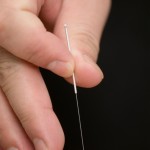
acupuncture
I often get asked “What’s the difference between IMS & acupuncture?”
Friday, February 13th, 2009 | General | No Comments
IMS stands for Intra-Muscular Stimulation. It’s a technique developed right here in BC by a Vancouver physician named Dr. C. Chan Gunn. I came across this treatment modality in 2002 when I was a patient at a Delta physiotherapy clinic. At the time, I had been wavering a little with regards to my passion about physiotherapy, while struggling with a toothache type pain down my right leg that was only quieted when I lay down. This went on for 8 months. After 6-7 sessions of IMS, I began to see the light at the end of the tunnel and a new “career” was in sight!
I couldn’t WAIT to offer this modality to my clients! I was so stoked. To this day, I get teased about how I seem to “enjoy” needling patients, as if I am cruelly taking “pleasure” in causing pain but I ASSURE you, I get excited about the potential healing that’s available with these little needles.
Compared to acupuncture which has been around for hundreds of years, IMS is a relatively recent “invention”. The needles used are the same in both treatments but the application combines conventional (or Western) physiological and anatomical knowledge with traditional (Eastern) techniques to produce a fusion, of sorts. I personally believe it’s a beautiful union of old with new, offering relief for clients who can not find any with regular physiotherapy or other body work, for example.
It’s application and success has been noted mostly in the reduction of chronic musculo-skeletal pain. Some examples of “conditions” treated with IMS are tennis elbow, low back pain, fibromyalgia, carpal tunnel or frozen shoulders, to name but a few.
IMS involves the insertion of needles into muscles who’ve shortened or contracted. Creating a tiny “wound” in the muscle encourages blood and healing materials into the area of the overly tight muscle. While tight, it doesn’t heal properly which leads to the chronicity of the condition. The muscle being needled “grabs” onto the needle and after a while, relaxes. This continues for some time after the needling is complete. By “twiddling” the needle, a greater response can take place.
Patients who have heard of IMS after having had acupuncture sometimes refer to is as the “painful” kind of acupuncture. It’s true that the treatment isn’t exactly pleasant, whereas traditional acupuncture can be quite calming and soothing. What I tell these patients is that the “intention” of IMS is STIMULATION- ie. to trigger a spinal cord reaction. Insertion of a needling into a “healthy” muscles does not produce the same reaction as into a tightened or contracted muscle. Many of my clients are actually relieved when the needle re-creates or “accesses” they pain, which until that point had seemed elusive or untouchable. The reasons for this may be that the muscle is deeper than can be easily reached with other techniques (such as deep hip muscles or paraspinal muscles) or because the needling unleashes a REFERRED pain that is what the patient experiences.
Note: a referred pain is one that is felt in a distant location from it’s source, and can seem to be unrelated. When some cardiac patients have left arm pain, this is sometimes a referral from the heart muscle itself.
So, in the end, the main difference in the techniques, I always say, is the “theory behind the application”. Here’s an analogy for you:
A friend was telling me the other day about alternate uses for coffee filters…from covering food being cooked in a microwave from splattering to protecting carpets when kids are eating popsicles…in IMS treatment, an acupuncture needle is being used alternatively to it’s traditional designation in treating meridians (or channels of energy flow in the body). IMS uses knowledge of anatomy and a western type medical exam to choose the appropriate needle points.
I am in no position to say that one is BETTER than the other nor am I implying one is better than the other. It’s simply a different application of an ancient tool!
Sue Shalanski BScPT has been trained in CGIMS by Chan Gunn and his associate instructors, completing her training in 2003 and enjoying helping her clients move freer and with less pain since then!
BOOKING

Online Booking

Our Therapists
Sue ShalanskiLinda Belanger
Mike Charuk
Shelley Cottle
Mina Kavia
Patrick McKinnon
Donna McMurtry
Angela Newton
Karen Ogilvie
Maggie Phillips-Scarlett
Our Location
1235 Village Green Way
Newsletters Subscription
Categories
- 100 Day Challenge Stories (11)
- 30 Day Challenge (26)
- General (14)
- Inspiration (7)
- Mind & Mountain (6)
- Team Interviews (4)
- The Chief Weight Loss Competition (7)


